Finch & Focus may earn a sales commission from merchant links on this page at no additional cost to you. How Finch & Focus is funded
For anyone stepping into birdwatching, nothing transforms the experience quite like a dependable pair of binoculars. Seeing a distant shape in the brush resolve into crisp wing bars, subtle eye-rings, and vibrant plumage is what turns casual outdoor walks into an engaging lifelong hobby. However, beginner birders often encounter confusing optical jargon—magnification ratios, prism glass types, and coating tiers—making the first purchase feel intimidating.
The standard recommendation for most newcomers is an 8x42 roof-prism binocular. This configuration offers an optimal balance: 8x magnification delivers a wide field of view that makes tracking flitting songbirds easy while keeping hand tremor to a minimum, and 42mm objective lenses gather ample light under dense woodland canopies or during dawn and dusk. Whether you want an optical upgrade with premium glass or an ultra-affordable starter set, here is how today’s popular options compare.
In a spec like 8x42, the first digit (8x) indicates how many times larger the subject appears compared to the naked eye. The second digit (42mm) measures the diameter of the front objective lenses in millimeters. Larger objectives let in more light for brighter views at dawn or dusk, but add physical weight to your neck strap.
Top Pick for Color and Contrast: Svbony SV202 ED
If your budget allows stepping slightly beyond entry-level glass, extra-low dispersion (ED) optical elements deliver a noticeable leap in performance. In birdwatching, chromatic aberration—often visible as distracting purple or green fringing along the high-contrast edges of a bird perched against an overcast sky—can obscure feather details and make species identification tricky.
The Svbony SV202 ED stands out in the entry-enthusiast category by integrating ED objective lenses with quality BaK-4 roof prisms. Available in versatile 8x32, 8x42, and 10x42 variants, it delivers improved color fidelity and sharp edge-to-edge definition. Its rugged IPX7 waterproof and fogproof rating ensures peace of mind when caught in sudden rain or moving between humid marshlands and air-conditioned vehicles.

Who it suits best: Beginners who want a pair they won't quickly outgrow, especially birders observing raptors against bright skies or waterfowl across open, sunlit lakes where chromatic fringing is most noticeable.
Balanced Value with Phase Coating: Vector Optics Paragon 8x42 / 10x42
Roof prism binoculars are naturally compact and streamlined, but because the internal light beam splits and recombines inside the prism housing, they can suffer from phase shift that softens image contrast unless treated with phase-correction coatings. The Paragon series pairs standard 8x42 and 10x42 configurations with phase-corrected roof prisms at an accessible price point.
With an IPX6 water-resistance rating and textured metal-accented focus hardware, it is built to handle rough woodland trails and sudden squalls. The 8x42 version provides a steady 5.25mm exit pupil, making quick target acquisition intuitive for novices whose hands may not yet be accustomed to holding optics steady for long periods.

Who it suits best: Field observers looking for solid contrast and dependable weather resistance in a standard full-size chassis without paying brand-name premiums.
Accessible Entry-Level Standard: Celestron Outland X Series
Celestron is a familiar name in consumer astronomy and sport optics, and the Outland X 8x42 / 10x42 provides a practical, low-friction entry point for curious naturalists. Full-sized 42mm objectives provide a generous entrance pupil that helps beginner eyes center comfortably over the eyepieces without experiencing blackouts (kidney-beaning).
While standard multi-coatings on entry-tier optics may yield slightly dimmer views in deep shade than ED-equipped models, the Outland X provides adequate clarity and waterproof exterior armor for backyard feeders, park walks, and casual nature outings.
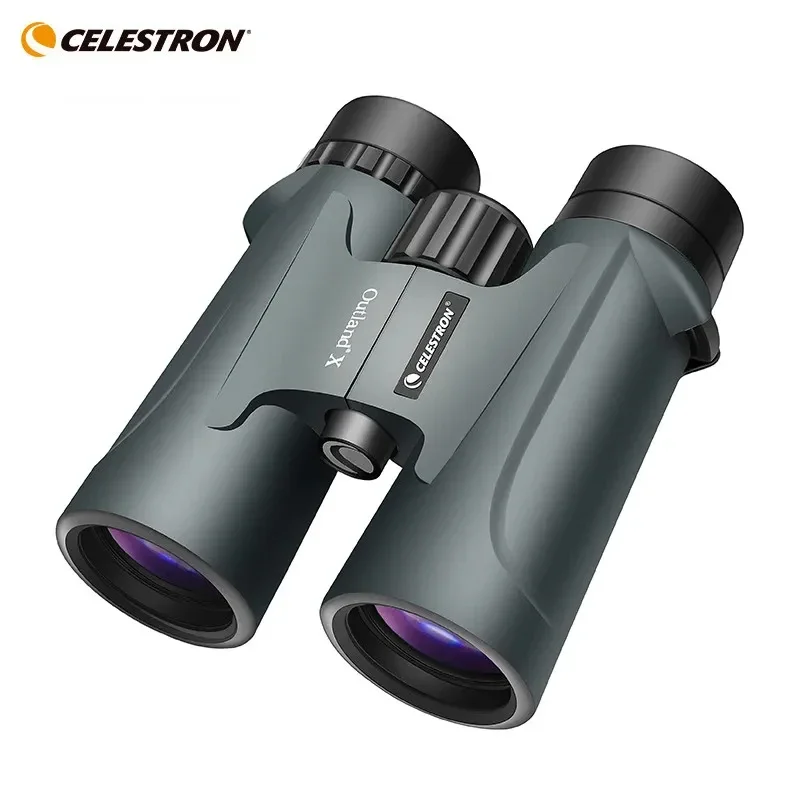
Who it suits best: Casual observers and families wanting a dependable, full-size backyard birding optic under $50.
Ultra-Light and Pocketable: 8x21 Folding Compacts
Full-sized 42mm binoculars weigh between 600 and 800 grams (1.3 to 1.7 lbs), which can feel burdensome during long hikes or casual travel. Dual-hinge folding compacts like the 8x21 Compact HD offer maximum portability, collapsing small enough to slide into a jacket pocket or daypack pouch.
However, physics imposes distinct trade-offs with 21mm objective lenses. An 8x21 optic yields a narrow exit pupil of just 2.6mm (21 divided by 8). In bright midday sunlight, your eye's pupil contracts, making the view bright enough for casual viewing. But in dim morning brush, dense forests, or near sunset, the small lenses struggle to deliver enough light. Eye positioning must also be far more precise to avoid dark rings around the periphery.
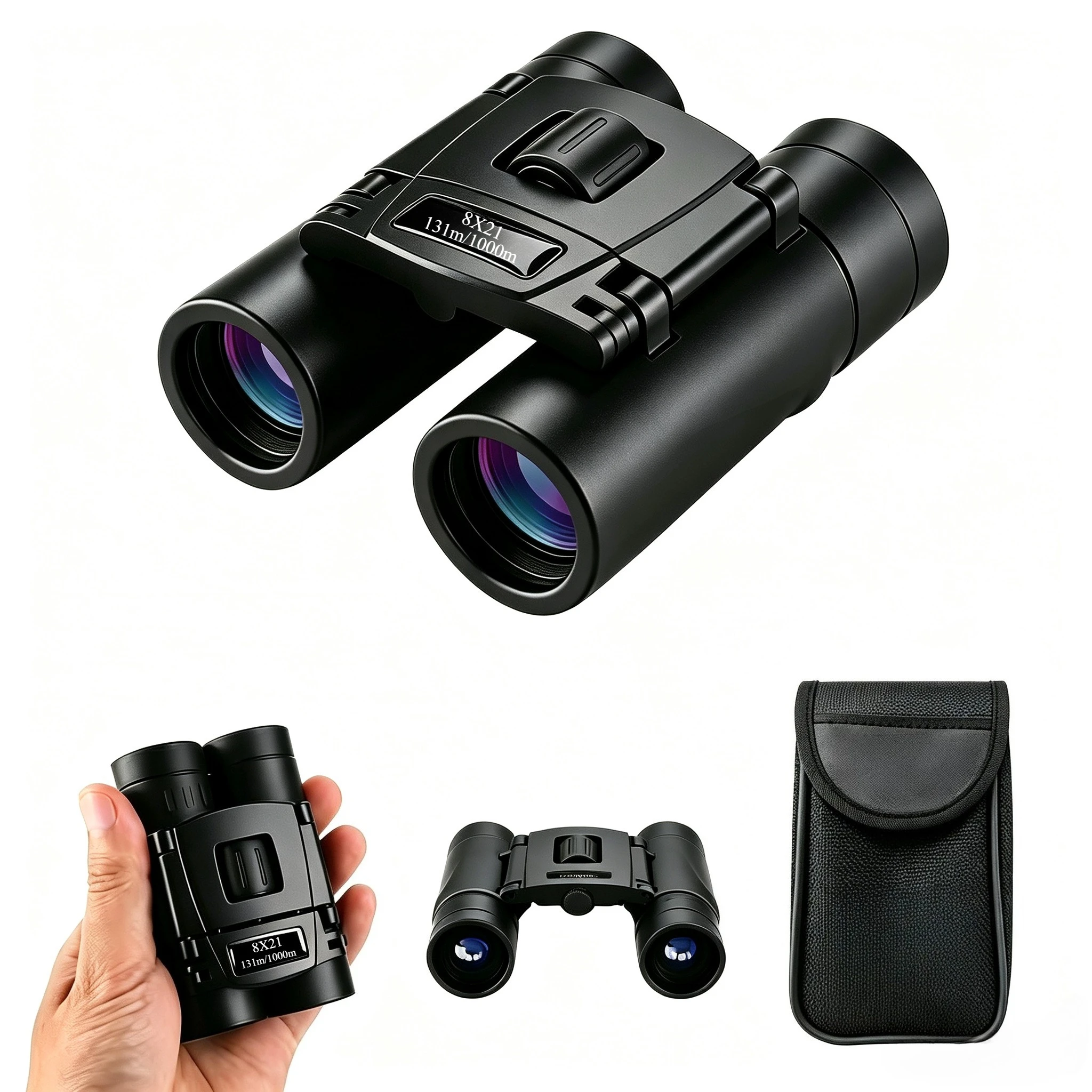
Who it suits best: Hikers, backpackers, and children who prioritize minimal pack weight over low-light brightness and wide fields of view.
How to Choose: Practical Buying Advice for Beginners
| Feature | 8x32 / 8x42 | 10x42 | 8x21 Compact |
|---|---|---|---|
| Field of View | Wide (Easiest to track birds) | Moderate | Narrow |
| Low-Light Ability | Very Good (42mm) / Good (32mm) | Good | Limited to bright daylight |
| Hand-Shake Tolerance | Very Stable | Sensitive to movement | Moderate (Lightweight twitch) |
| Ideal Environment | Woods, thickets, all-round | Shorelines, open fields, wetlands | Travel, ultralight trekking |
Key Setup Steps Once Your Binoculars Arrive
- Set the Interpupillary Distance: Bend the central hinge until the two circular images merge into one single, clean circle with no black shadows in your field of vision.
- Adjust Eyecups for Eyeglasses: If you wear glasses, twist the eyecups down completely so your lenses sit closer to the ocular glass. If you do not wear glasses, twist the eyecups out to maintain proper eye relief.
- Calibrate the Diopter: Close your right eye (or cover the right lens) and use the center focus wheel to bring a distant branch into sharp focus with your left eye. Next, switch eyes: close your left eye and turn the right diopter adjustment ring on the right eyepiece until that same branch is razor-sharp. Lock it in place. From this point forward, use only the center wheel to focus.
For most beginning birdwatchers, starting with an 8x42 model like the Svbony SV202 ED or Vector Optics Paragon strikes the most satisfying balance between field stability, clear twilight viewing, and swift target acquisition on the trail.